Beautiful, Bizarre, and Free: Antique Images for Your Next Creative Rabbit Hole

Some people collect sensible things. I collect images that make me say, “That would look lovely printed on canvas for my bathroom,” immediately followed by, “Why is there a demon in that shrub?”
This collection has range: delicate flowers, spectacular frogs, mysterious diagrams, and gentlemen whose head shapes supposedly reveal whether they’re husband material. Naturally, I thought you needed them.
These 15 antique images are free to download and reuse, ready for junk journals, collages, handmade cards, and whatever wonderfully peculiar project you’ve been putting off.
And because the librarian in me cannot simply hand you a strange picture and walk away, here’s a little history.
Before dating apps, apparently there were head diagrams

Excellent hair. Questionable method of evaluating parenting skills.
Several images come from L. A. Vaught’s Practical Character Reader, published in 1902. The book promoted phrenology and related ideas about judging character through the shape of the head and facial features. Its illustrations confidently identified qualities such as practicality and parental love.
The collection even includes “A Genuine Husband.” Imagine bringing someone home and having your family request a side view before approving the relationship.
These are examples of discredited pseudoscience, not useful personality tests. Their value today is as historical artifacts, and reminders that a confident diagram does not make a claim true.
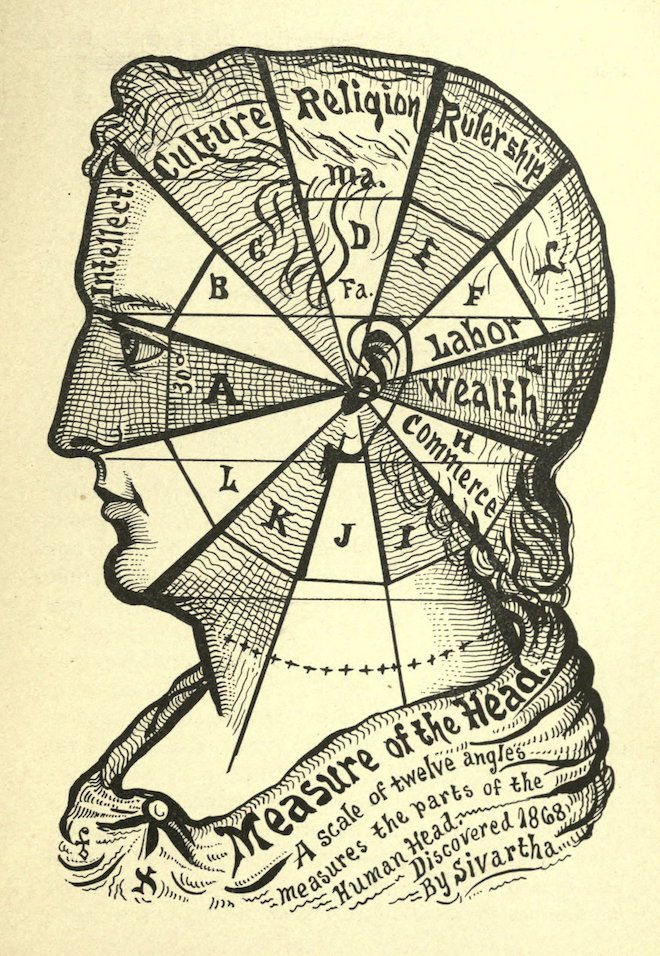
A brain with everything neatly labeled
Other intricate heads and the densely labeled hand come from Dr. Alesha Sivartha’s The Book of Life: The Spiritual and Physical Constitution of Man (1898). Sivartha blended ideas about science, society, spirituality, and religion into an elaborate system, including brain diagrams divided into twelve sections.
Visually, they’re fascinating. Every inch seems to have a job.
If someone mapped my brain, they would need substantial space for “old paper,” “books I intend to read,” and “where did I put my scissors?”
Use these as conversation-starting collage elements or journal covers. Treat the theories as historical curiosities.
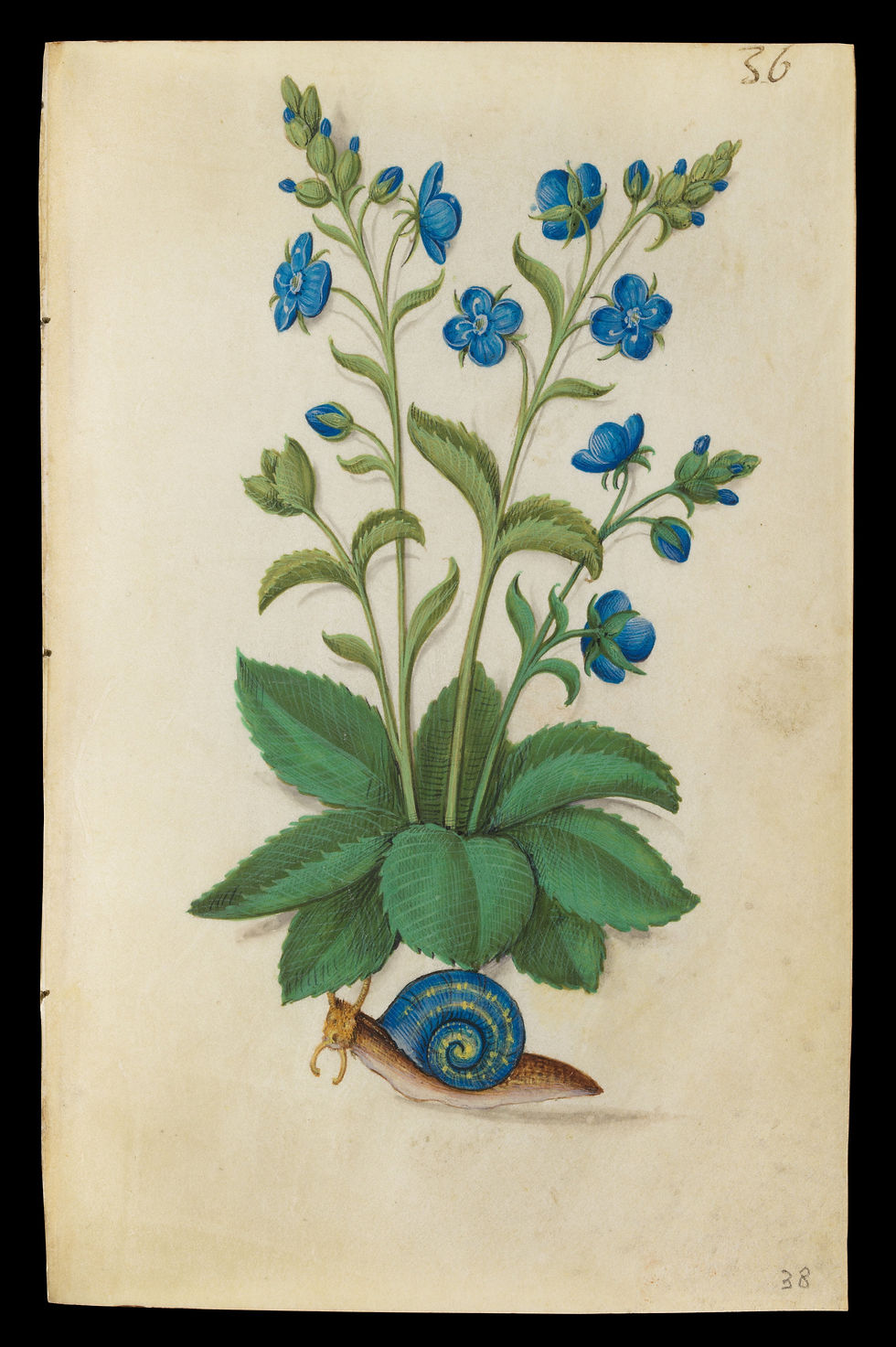
Flowers, a snail, and a small moment of peace.
The snail has no deadlines and will not be taking questions.
This lovely blue flower is speedwell, from the Book of Flower Studies, dated around 1510–1515 and associated with the workshop of the Master of Claude de France. The manuscript belongs to the tradition of finely painted illuminated books, and this image is now held by the Metropolitan Museum of Art.
More than five centuries later, it still makes a convincing argument for slowing down and looking closely. It would be beautiful on a bookmark, botanical journal page, or handmade note.
When the garden came with supernatural pest control
The plant page with a little dark creature comes from Tractatus de Herbis, around 1440. This illustrated herbal helped physicians and apothecaries identify plants across language barriers. The pictured Ypericon was associated with repelling demons.
My gardening goals are usually “keep the basil alive,” so this feels ambitious.

It’s a wonderful example of how practical plant knowledge and older beliefs could share the same page... and an excellent addition to an apothecary-themed journal.
And then there’s the medical department
The collection takes a stranger turn with illustrations from Georg Bartisch’s 1583 eye-care treatise, Ophthalmodouleia, which discussed eye diseases, surgical methods, and instruments in German rather than Latin.
There’s also a mid-fifteenth-century “wound man,” a figure displaying numerous injuries. Such images appear to have catalogued the different ways a body could be harmed, sometimes alongside treatment information. Think of it as a very early medical reference illustration having an exceptionally difficult afternoon.
Give these old images a new life
Try them as:
Junk journal pockets, tags, and layered pages.
Bookmarks, greeting cards, and small framed prints.
Collages combining beautiful botanicals with decidedly strange diagrams.
Classroom prompts about historical beliefs and how knowledge changes.
Enjoy this free collection from Toadstool Thrift & Craft. Download a favorite, make something unexpected, and let these old illustrations have another adventure.
Just please don’t choose your next husband by the back of his head.


Comments